Meaningful Classroom Work
Cumulative, Developmental Assignments

For all of my complaints about AI, today’s post is the result of one clear benefit of the AI upheaval: better assignments. When I lost term papers, I was forced to reinvent and reimagine assessment. I am so glad I was. I am grateful.
Don’t get me wrong, it’s exhausting. It is also so very good. When I was forced back to the drawing board, I realized there were questions I had never bothered to ask, questions I ought to have asked long ago.
Some of those questions were practical pedagogical questions, like how to balance passive and active learning over the course of a semester, or how to design assignments that encourage and incentivized student investment. As an educator, these are things I should have thought more carefully about at the outset. I didn’t, mostly because I didn’t have to. There was a clear formula; following that formula made sense. It has taken some distance to see that the old method, for all that it got right, had weaknesses and failures of its own.
As I have shared, when I began to change my classroom approach, I did so as a reaction against the coming AI threat. My motivation was purely defensive; I was not especially optimistic. My motivations are no longer (primarily) defensive. I am a convert to the benefits of low-tech, slow, developmental work. I have even come to see the benefits of surrendering some of the time I previously spent lecturing and the costs of an exclusively lecture-centered classroom.
In the process, I have begun to ask questions of another kind—less pedagogical, more philosophical and theological. I have been “reinventing” my classroom for at least four years, but I have only recently begun to think through the deeper ties that bind my overarching attitude towards education.
Connecting the Dots: A Homeschooling Professor
Fun fact: I spent over a decade feeling that my life was bifurcated: M/W as a homeschooling parent, T/Th as a college professor, with Friday and Saturday to use as needed. It never bothered me! I always found it a little funny, and a lot more interesting than the alternative. I have always (always!) loved variety
A few months ago, I wrote a response to Hollis Robbins in which I worked to capture my (distinctly and essentially human) hope as an educator. More recently, I set out to correct the record after an article from The Economist left me feeling as if our interview with them had been a sham.
Finally, it clicked. There is no bifurcation. I teach as I do, and I homeschool as I do, because I believe that a good education should always be something like invitation and inspiration. We are people, not machines. That matters. I can’t think of anything that matters more. Education is always the education of a person.
I want to be starting fires and opening doors, not ticking boxes and tying bows. I want my children and my students to know that, whatever they feel they have mastered, there is always more to learn. I want this for them because it is the truth. There is always more to learn.
The student who has taken 2 philosophy classes and considers himself an expert on Kant is mistaken, as is the college senior who believes she has mastered Aristotle.
The student who takes himself to know all that his large language model can tell him? This is self-deception beyond all reason.
Going forward, I want all of my assignments to reflect this commitment. I want to teach with an eye towards what we are, and what education can be.
Quick Story
Some of my favorite family photos involve my husband working and the children “helping.” The photo below is a candid shot I took a few years back. They did not, as far as I know, deliberately line up in height order. The oldest was probably the first to help, with his sister following. The youngest, armed with what seems to be a watercolor brush, has never wanted to miss any sibling action.
So here they are, staining the fence.
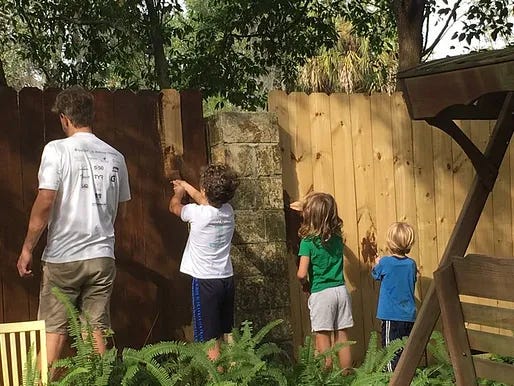
Now imagine if my husband had taken a different approach to their interest.
“Oh you want to paint, too? Sure. Start with this paint-by-numbers book, or a piece of scrap wood.”
I don’t know about your children, but mine would have gone off to find something else to do. They didn’t want to paint in general; they wanted to do what he was doing, with him. They wanted to help.
In the classroom, how often are our assignments responsive to this human desire to participate? Do they feel more like grabbing a brush to join an ongoing project, or being handed a rudimentary worksheet?
My goal is to do more of the former and less of the latter. More inviting & inspiring, less box-ticking and content-delivery.
What Does This Look Like?
One of the ways I am working towards this goal is by designing scaffolded assignments—and not just papers.
Students do not begin the semester ready to dive in to professional work. They have to start small, and those small assignments can feel trivial. The beauty of a well scaffolded series of assignments is that the skills developed at the beginning are those most needed in the end. Even a moderately reflective student can come to see, over the course of a single semester, real benefits from what might otherwise have felt like busywork. In some classes, the easiest way to accomplish this is with a scaffolded term paper. In other classes, a paper is not quite right.
To repeat: a scaffolded assignment does not have to be a paper!
The main goal, as I see it, is to do something like the following:
Begin with frequent, easy-entry assignments. These should prioritize attendance & preparation, where the latter means genuine engagement with assigned materials.
Be explicit about your pedagogical motives. This does not have to be long or profound; quick and simple is effective: “Remember, the goal of these in class prompts is to strengthen your ability to find and use with textual evidence,” or “Remember, if you find this topic compelling, make a note to incorporate it into your final paper. It’s easier to write about things that you find interesting or important.” The point is to remind them that the small assignments are a part of a larger project. They serve a purpose; they are not busywork.
Do your best to give larger assignments that build upon the work being done in the smaller ones. Ideally, your students should be able to see that they were better equipped for the midterm (or paper, or project) because they had been doing the in-class work.
Finally, aim to foster and reinforce habits that your students can take with them when the semester ends. We’ve all seen the studies on student retention; I don’t expect most of my students to remember the difference between functionalism and physicalism in ten years’ time. I do hope that they continue to read carefully; I hope they remember that they are able to read hard things. I hope they carry with them an ability to seek answers in a text, an interest in reading for understanding, and a commitment to the principle of charity.
One Concrete, Non-Paper Example: Teaching Biomedical Ethics
This morning, I kicked off another semester of Biomedical Ethics and I am excited.
This excitement is a surprise even to me. For many years, I hated teaching Biomedical Ethics. Despised it. Eventually, I sent my department head an email demanding requesting a break from the course until I could find a better way to handle the material.
Here’s what I used to find so difficult:
Too many students treated the course material like a series of boxes to be ticked. That happens in any class. It may be, to a certain extent, inevitable. Still, in a class structured around actual questions of life and death, the problem felt more acute. By encouraging my students to treat even these questions as busywork, I worried that I was contributing to a kind of moral malformation.
It wasn’t just that the students had a tendency to treat cases as puzzles to be solved. What genuinely concerned me was the nearly ubiquitous tendency to use ethical theories as pragmatically interchangeable tools.
Instead of seeing each moral theory as a wholistic, largely fixed framework of commitments, students tended to use them interchangeably to defend whatever intuition they had at the moment. They were happy utilitarians for one case, committed virtue ethicists for another—a tool for every task, a theory for every case!
Clearly, I was doing something wrong. Until I could establish what it was, I needed a break.
My breakthrough came through two initial sources: my husband, who recommended I try medical memoirs instead of a textbook, and my introduction to the podcast Bioethics for the People.
My First Pass: Group Work that Actually Works
When I finally returned to teaching Biomedical Ethics, my reentry came with a new wrinkle: a class of 90 students. My classes tend to average around 40 students, ranging from 15 to 50. I have friends who teach sections of 400, and I have no idea how they do it. For me, 90 is enormous.
My solution was threefold:
I replaced the textbook with podcasts and medical memoirs,
I supplemented with mini-lectures, giving the basic philosophical content that the text would otherwise have provided, and
I structured every class around guided, genuinely useful group work.
I loved it. Most of my students loved it.
The semester felt daunting at first, largely because I made so many changes at once. To be frank, it was fairly terrifying at the outset.
In the end, it felt like a serious success.
I shared the details of those initial assignments here:
Rather than repeat the content from an old post, I will briefly share what I found most beneficial about my new approach:
By using high quality podcasts and medical memoirs, I was better able to communicate the human stakes of every case we discussed.
By using peer-graded small groups, I was better able to establish a community in the classroom, making space for a wider of variety of students to participate.
By challenging each group to directly apply the lecture content to the assigned podcast, I required students to actively synthesize course material in every class. (This turns out to be an immensely effective strategy for comprehension and retention.)
I tried a similar approach for an Introduction to Philosophy class, and it worked nearly, but not quite, as well. If you are looking for a new approach for your own courses, give this a try! Then let me know how it works out, for good or for bad!
Upcoming Changes: More Scaffolding!
This semester, instead of 90 students, I will have two sections of my usual size. Even so, I am sticking with the group work model. It fits the content.
In retrospect, it is clear to me that a class like this needs an assignment that prioritizes group interactions. For that reason, I am also adding a new major assignment at the end of the semester: a graded in-class debate over a case.
Here is why:
All semester long, my students will be discussing complicated, controversial cases in small groups. They will have to learn how to disagree well, how to listen to one another with charity and patience, and how to communicate their own ideas in a way that others can understand.
At the same time, they will be working through cases for which there is no obvious or agreed-upon solution. I don’t mean that every case we consider will be controversial one; some will center decisions or practices that would now be universally condemned. But some of what we encounter will be genuinely difficult to navigate, like the case of Ashley X.
What better way to bring these practices together than by inviting the students to act as an ethics board? In this assignment, students will:
Apply the philosophical content that they have learned from the course lectures and assigned materials,
Use the habits and behaviors they have developed in their regular group discussions,
and pull it all together into a coherent, polished, whole.
They will be asked to listen to one another, with charity. They will be asked to defend and explain their group’s position, making use of some of the shared core commitments held in common by most bioethicists. They will be tasked with maintaining their composure, fielding questions, considering objections.
In short, they will take all that they have been working on over the course of the semester and bring it one step closer to the kind of work they may one day do, should they pursue a career in clinical or biomedical ethics.
The benefit is not lost to those who have no interest in a career in this field. Even if this course is the only one they take on the topic, the final debate enables every student to see the fruit of their in-class labor.
Or so I hope!
Feel free to share your thoughts, good or bad. I’m always looking for feedback. It’s a tough time to be teaching, but that difficulty can be a benefit.
The benefits increase when we work together, sharing our successes and our failures.
Hey Dolores! Any thoughts on transferring these lessons to online classes? Alex has been giving me all the remote classes nobody else wants to take 😂😭